Services
Company
Legal and Governance


Insights / Articles
At the ESMO Congress 2025, held last month in Berlin, AI was a frequent thread in the presented content. The event, sponsored by the European Society for Medical Oncology (ESMO), was attended by some 37,000 clinicians, researchers, and others with a compelling interest in oncology. In abstracts, posters and presentations, AI-powered tools were shown to influence how data are created and deployed in clinical, regulatory, and reimbursement settings.
ESMO 2025 reinforced that AI’s potential in oncology depends on disciplined validation and thoughtful integration, not just technological progress. Even as AI reshapes how oncology evidence is generated, the quality of that evidence will rely on the transparency and accountability that are built around it.
All this signals that teams leading evidence generation, including in Medical Affairs and HEOR & Market Access, are at an important turning point. As oncology continues to advance toward precision medicine, evidence strategies must adapt to both the complexity of AI-enabled data and the increasing expectations of stakeholders who rely on it.
The following examples provide a brief snapshot of how innovations in AI are being translated into real-world practice today and redefining how oncology evidence is generated and applied.
AI foundation models and clinical relevance
AI foundation models trained on electronic health record data have continued to evolve.¹ Although they can identify patient patterns and predict outcomes at scale, these models still depend on limited datasets and validation metrics that are not clinically meaningful. There was a call for wider, multi-institutional collaborations and medical-specific benchmarking frameworks that assess AI performance using endpoints such as survival, disease progression, and toxicity.
A validation framework for AI biomarkers
The ESMO Basic Requirements for AI-Based Biomarkers in Oncology (EBAI) framework was introduced at the event in advance of publication in Annals of Oncology. Developed from a modified Delphi consensus process involving a panel of 37 experts, the publication offers guidance on using AI-derived biomarkers in cancer treatment, classifying them by novelty and evidence requirements²:
Each tier requires a proportionate level of validation, from analytical reproducibility for Class A to prospective clinical validation for Class C.
This framework provides a common reference point for aligning AI innovation with clinical and regulatory expectations, supporting trust across the oncology ecosystem.
Digital trials and engagement as evidence
Digital and decentralized trials were a central focus at ESMO 2025, highlighting their role in improving trial efficiency, retention, and diversity. Retention was reframed as an evidence-quality measure rather than an operational challenge. A conceptual model, presented at the congress, described four drivers of patient retention: reducing barriers, building community, integrating participation into daily life, and ensuring consistent follow-up.³
Supported by AI-enabled analytics and communication platforms, these design features can improve participant continuity and data representativeness in oncology research.
TrialMatchAI and eligibility optimization
Equally significant was the focus on AI-assisted trial operations, including the introduction of TrialMatchAI, an open source trial-matching platform that integrates structured and unstructured patient data.⁴ The system interprets trial eligibility criteria using natural language models and performs criterion-level analysis to determine patient fit. By providing explainable results for investigators, this approach can increase transparency, reduce screen-failure rates, and accelerate enrollment.
Synthetic data and federated learning: Innovation with caution
Synthetic data and federated learning were key areas of discussion at the congress. Synthetic datasets were described as useful for feasibility modeling and exploratory analysis but not as substitutes for real patient data. It was pointed out that synthetic data are “only as good as the real input data,” underscoring the need for rigorous validation to minimize overfitting and bias. Federated learning, which allows models to train across institutions without sharing sensitive information, was positioned as a promising approach to enable privacy-preserving collaboration across research centers.⁵
Key Takeaways
The ESMO Congress 2025 highlighted that the next phase of oncology evidence generation will depend on how effectively AI is integrated into existing research, regulatory, and access frameworks. For evidence generation stakeholders, several strategic priorities emerged that can guide both near-term planning and long-term capability development.
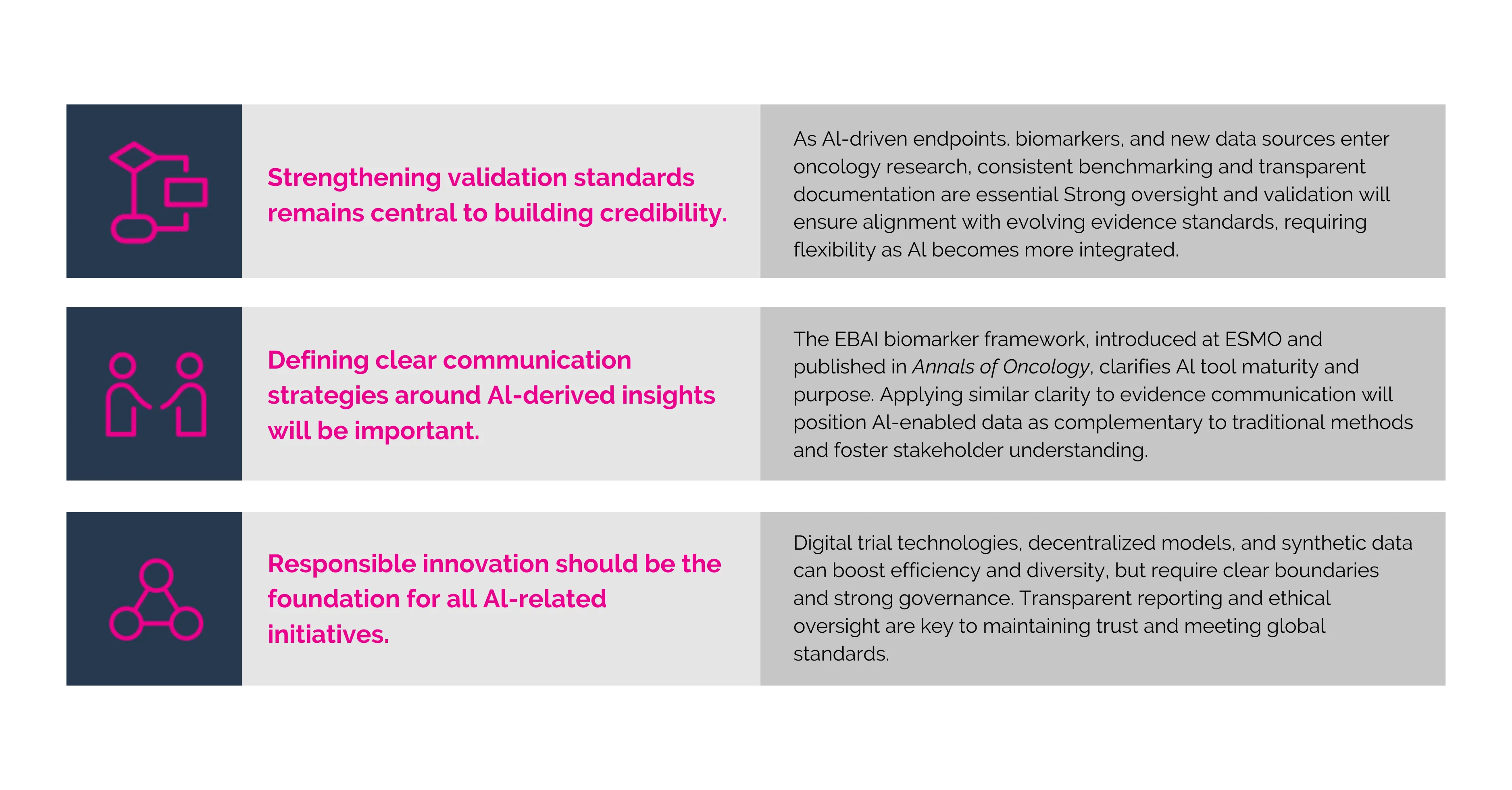
Taken together, the discussions at ESMO Congress 2025 signal that oncology evidence generation is entering a hybrid era in which AI and traditional research approaches converge. Building on this momentum will require continued collaboration, transparency, and commitment to quality to ensure AI strengthens the integrity and impact of oncology research.
At OPEN Health, we connect visionary minds, pioneering science, and advanced technology to drive real impact. By uniting people, science, and technology, we activate new opportunities for biopharma innovation. Our expertise across medical affairs and market access unlocks faster, smarter routes to market. We are committed to improving patient outcomes worldwide.
CAN WE HELP?
For information about OPEN Health’s services and how we could support you, please get in touch.
JOIN US
Visit our careers page to view opportunities at OPEN Health.
References