
Translating scientific advances in viral hepatitis into informed decisions and improved patient outcomes
Over the past three decades, the viral hepatitis therapeutic landscape has undergone a remarkable transformation – from broad-spectrum therapies associated with modest efficacy and considerable tolerability challenges to highly targeted treatments that have made hepatitis C curable for many patients and redefined expectations for hepatitis B and D. This pace of change is what led the World Health Organization (WHO), a decade ago, to set the ambitious goal of viral hepatitis elimination by 20301.
Today, across HBV and HDV, an expanding pipeline of investigational therapies targeting multiple stages of the viral lifecycle, including viral entry, replication, antigen production, capsid assembly, and host immune responses, is driving a shift from long-term disease management toward finite treatment strategies and durable functional cure. At the same time, advances in biomarker science, including quantitative HBsAg, HBcrAg, HBV RNA, and other emerging viral and immune markers, are enabling more precise patient stratification, treatment monitoring, and endpoint assessment, supporting a future of increasingly personalized and biomarker-driven care2.
Yet as treatment possibilities expand, so too do the frameworks and policies needed to translate them into practice. The complexity of implementation is highlighted by this year’s World Hepatitis Day theme of “Let’s Break it Down” – viral hepatitis stakeholders are increasingly required to understand new therapeutic approaches, emerging biomarkers, real-world evidence, and evolving models of care, while adapting to rapidly changing treatment goals and clinical paradigms3.
In other words, achieving global viral hepatitis elimination is no longer solely a scientific endeavor; it is equally a communication challenge. As the evidence base expands and care pathways evolve, stakeholders require clear, relevant, and actionable information to support informed decision-making and meaningful engagement. By translating scientific innovation into practical insight, medical communications can help bridge the gap between evidence and action – supporting treatment uptake, improving patient outcomes, and sustaining momentum toward global elimination goals.
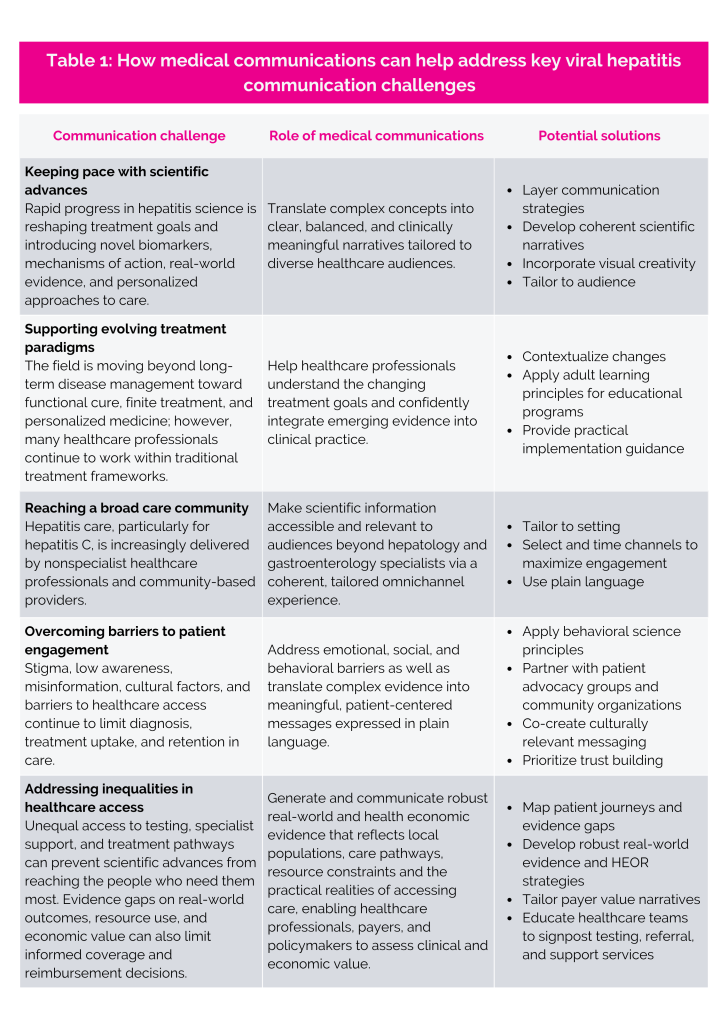
Below, we highlight some of the key communication challenges facing the viral hepatitis community, alongside potential strategies that medical communications can employ to support awareness, understanding, and progress toward the WHO elimination goals (Table 1).
This World Hepatitis Day is an opportunity to reframe the challenge facing the scientific and medical communications communities. As treatments, biomarkers, and models of care continue to evolve, the need for clear, accurate, and impactful communication has never been greater. By transforming complex evidence into accessible and actionable knowledge, medical communications can help ensure that scientific progress translates into meaningful improvements in clinical practice and, ultimately, better outcomes for patients worldwide.
Abbreviations
- HBcrAg, hepatitis B core-related antigen
- HBsAg, hepatitis B surface antigen
- HBV, hepatitis B virus
- HBV RNA, hepatitis B virus RNA
- HDV, hepatitis D virus
- HEOR, health economics and outcomes research
References
- World Health Organization. Global health sector strategy on viral hepatitis 2016–2021: Towards ending viral hepatitis. 2016. https://www.who.int/publications/i/item/WHO-HIV-2016.06 (accessed July 2026).
- European Association for the Study of the Liver. EASL Clinical Practice Guidelines on the management of hepatitis B virus infection. J Hepatol. 2025;83:502–583.
- World Hepatitis Alliance. World Hepatitis Day: Let’s break it down. 2026. https://worldhepatitisday.org/ (accessed July 2026).