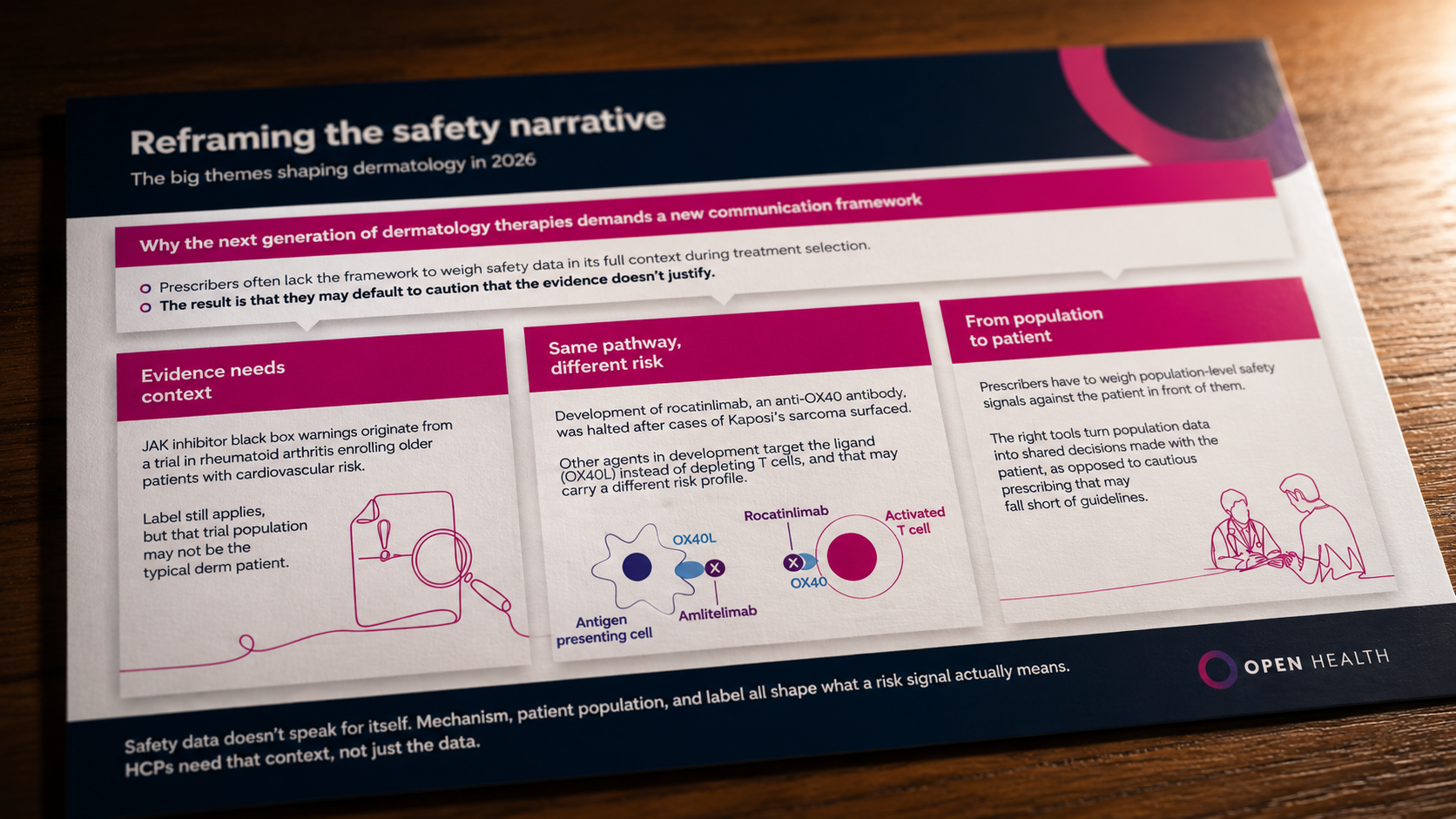
OPEN Health has worked across therapeutic areas long enough to see the same failure mode recur: prescribers get safety data they lack the framework to weigh, and may default to caution that the evidence does not justify. We are currently seeing this pattern play out with the use of JAK inhibitors and early signals from emerging assets targeting the OX40/OX40L pathway.
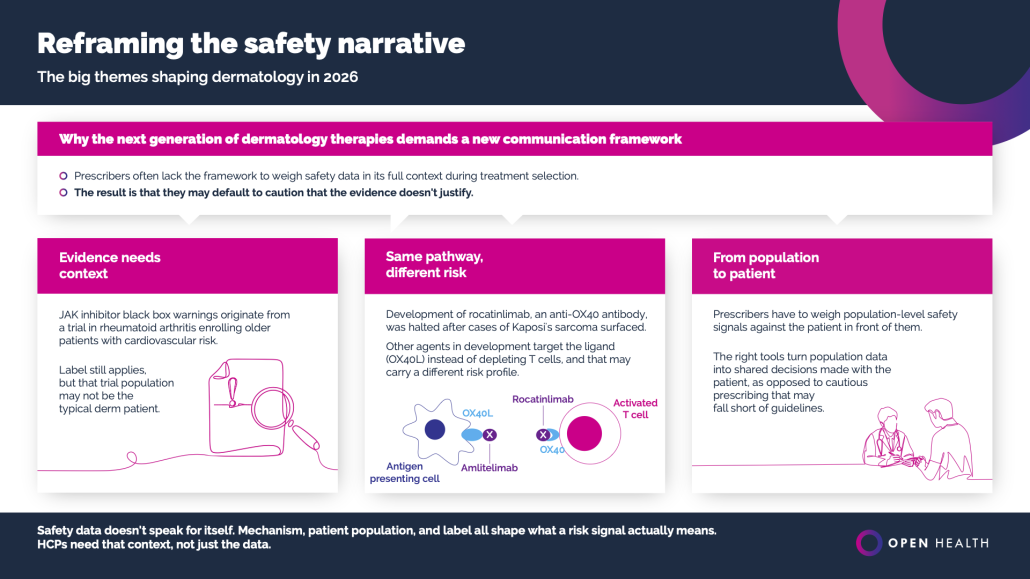
Translating safety data into clinical decision is rarely as straightforward as prescribers would need it to be. A trial population, an exposure window, a comparator arm, each one changes what a signal actually means, and a single black box warning can flatten the difference between a risk established in the population studied and a risk assumed for everyone else. That gap between what the data show and what the label says is where medical communications either does the work of closing the distance for prescribers, or leaves them to guess, usually erring toward more caution than the evidence supports.
Take, for instance, prescriber hesitancy around JAK inhibitors in dermatology, which has not disappeared despite clear guidelines. American Academy of Dermatology recommendations now position JAK inhibitors alongside biologics as the standard of care in moderate-to-severe atopic dermatitis,1,2 yet the FDA black box warning for major adverse cardiovascular events (MACE), malignancy, and venous thromboembolism (VTE) continues to create friction at the point of prescribing. The communications problem here centers on the failure to contextualize the evidence in light of the population studied.
The black box originates from the ORAL Surveillance trial, conducted in patients with rheumatoid arthritis who were aged 50 or older and carried established cardiovascular risk factors.3 That population is categorically different from the typical younger adult with atopic dermatitis presenting to a dermatologist. A large 2025 global cohort study found no significant increase in MACE or VTE in atopic dermatitis patients treated with JAK inhibitors versus non-JAK systemic therapies,4 consistent with the cardiovascular safety profile seen across randomized controlled trials in patients with atopic dermatitis.5 Real-world data do suggest some thromboembolic signal versus dupilumab in certain populations,4 reinforcing that risk stratification by patient profile matters, and that the answer is not to ignore the label but to read it with appropriate clinical context.
The OX40/OX40L pathway introduces a different order of complexity. The discontinuation of rocatinlimab, an anti-OX40 receptor antibody, in March 2026 followed two confirmed and one suspected case of Kaposi’s sarcoma among malignancies flagged during a planned safety review.6 Phase 3 results across three trials (COAST 1, COAST 2, and SHORE) of amlitelimab, an OX40L antibody, were presented at AAD 2026 and appeared to suggest an acceptable safety profile.7 Sanofi has since announced that it will not submit amlitelimab for regulatory review in AD, characterizing that decision as program-related rather than safety-driven. 8 A phase 2 trial of amlitelimab in celiac disease remains ongoing and multiple pipeline agents targeting this pathway remain in development, both as standalone OX40/OX40L blockers and as part of bispecific approaches,9 so the pathway itself is not in question, only which agents within it will show meaningful benefit.
This illustrates a principle with broad implications: agents targeting the same pathway can have distinct immunological risk profiles depending on their mechanism of action. Rocatinlimab depleted T cells via the OX40 receptor; amlitelimab took a non-depleting approach by blocking the ligand rather than the receptor.10,11 Whether this mechanistic distinction is biologically meaningful and fully explains the difference in safety signals remains an open question: the amlitelimab program reported two Kaposi’s sarcoma cases across approximately 4630 patients7. What is clear is that HCPs cannot navigate this class on the basis of a shared label. They need a framework for thinking about mechanism of action and its safety implications.
The same dynamic plays out in alopecia areata, where JAK inhibitors have demonstrated efficacy in restoring hair growth.12 Prescribers face the same task of weighing the safety signal derived from a different patient population. Structured, evidence-grounded educational tools that help HCPs contextualize population-level risk data for the individual patient in front of them are the difference between guideline-aligned prescribing and guideline-adjacent hesitancy.
Is your safety communication keeping pace with the evolving evidence? OPEN Health builds risk-stratified educational frameworks that translate complex mechanistic and epidemiological data into tools HCPs can actually use.
If your asset is navigating any of these conversations around mechanism, safety context, or the space between the label and the evidence, talk to us.
References
- Davis DMR et al. Focused update: Guidelines of care for the management of atopic dermatitis in adults. J Am Acad Dermatol, 2025; 93, 745.e1-745.e7. Link
- Davis DMR et al. Guidelines of care for the management of atopic dermatitis in pediatric patients. J Am Acad Dermatol, 2026; 95, 121.e1-121.e26. Link
- Ytterberg SR et al. Cardiovascular and cancer risk with tofacitinib in rheumatoid arthritis. N Engl J Med 2022;386:316–326. Link
- Kridin K et al. Cardiovascular and thromboembolic risks of JAK inhibitors in atopic dermatitis: A global cohort study. J Eur Acad Dermatol Venereol 2025;39:2088–2095. Link
- Dasilva DR and Bader K. Contextualizing the JAK inhibitor black box warning in dermatology. Dermatology Times. (accessed August 2026). Link
- Schaffer R. Kyowa Kirin halts all clinical trials for rocatinlimab, citing safety concerns. Healio. (accessed August 2026). Link
- Sanofi. AAD 2026: new results from amlitelimab phase 3 studies presented in late-breaking research session. (Accessed August 2026). Link
- Sanofi. Sanofi announces decision not to submit amlitelimab in atopic dermatitis for global regulatory reviews. (Accessed August 2026). Link
- Chovatiya R and Eichenfield L. Overview of emerging OX40 pathway–targeted therapies in development for atopic dermatitis. Dermatology Times. (accessed August 2026). Link
- Krueger JG et al. In vitro evidence demonstrating the nondepleting mechanism of action of amlitelimab, an OX40 ligand monoclonal antibody. Acta Derm Venereol 2025;105:adv43608. Link
- Abdelhalim A et al. A narrative review of the OX40-OX40L pathway as a potential therapeutic target in atopic dermatitis: Focus on rocatinlimab and amlitelimab. Dermatol Ther (Heidelb) 2024;14:3197–3210. Link
- DiRuggiero D and Kucera K. Efficacy, safety and real-world aspects of Janus kinase inhibitors to treat patients with alopecia areata. J Drugs Dermatol 2026;25:204–210. Link.