The biologic era in dermatology has reached maturity. The question that once dominated clinical conversations— “Are biologics better than corticosteroids?”—has been answered. Today’s conversations are more complex: comparative efficacy in biologic-experienced patients, class-specific safety trade-offs, and treatment sequencing. In that context, the central medical communications challenge has shifted. It is no longer enough to explain what a drug does. The field now demands a compelling answer to why this mechanism matters more than the last one and where it fits in the treatment pathway.
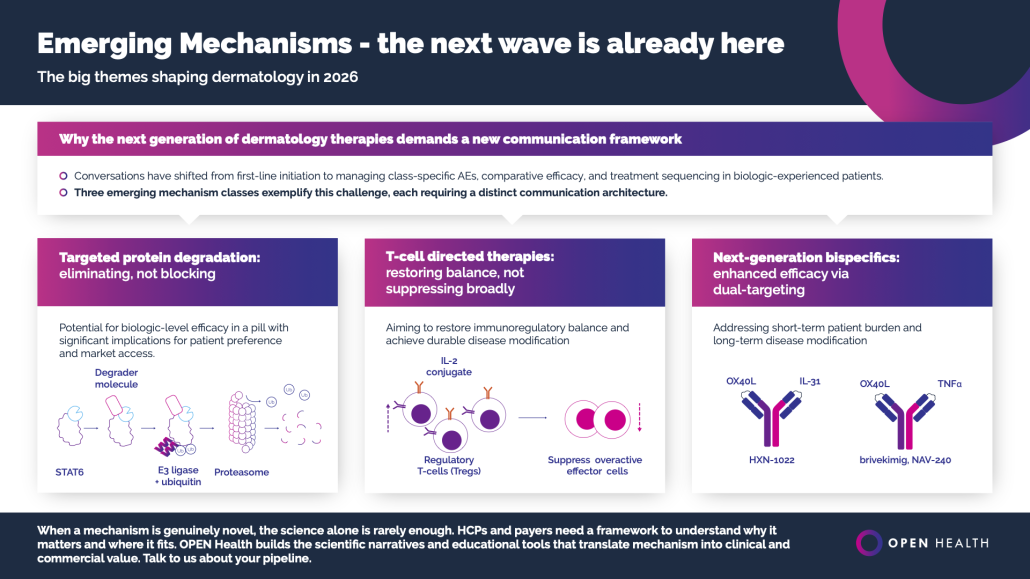
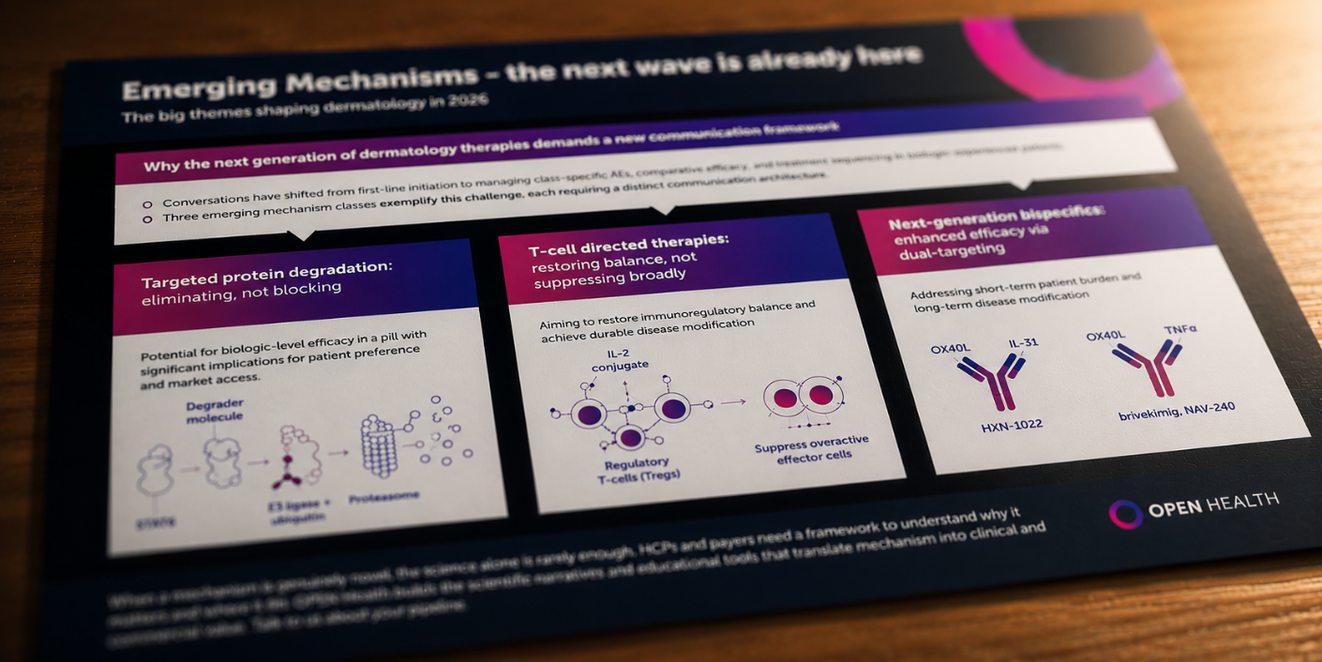
Three emerging mechanism classes raise this challenge in sharp focus, each requiring a distinct communication architecture.
Targeted protein degradation: Eliminating, not blocking
KT-621 (Kymera Therapeutics) is a first-in-class, once-daily oral STAT6 degrader. Rather than blocking IL-4/IL-13 signaling, it hijacks the ubiquitin-proteasome system to eliminate STAT6 entirely. It represents a pharmacodynamic story that is categorically different from existing biologics or JAK inhibitors. Positive Phase 1b results and FDA Fast Track designation for atopic dermatitis1 have set the stage for the Phase 2b BROADEN2 trial, now enrolling, with data expected mid-2027.2 The potential narrative that arises, biologic-level mechanistic depth in a once-daily pill, carries significant implications for patient preference and access strategy.
T-cell–directed therapies: Restoring balance rather than broadly suppressing the immune system
Rezpegaldesleukin (Nektar Therapeutics) is a selective IL-2 conjugate that preferentially expands regulatory T-cells, aiming to restore immunoregulatory balance rather than block a single cytokine pathway. Phase 2b results presented at AAD 2026 showed rapid onset, deepening responses at 52 weeks, and durable efficacy with maintenance dosing as infrequent as quarterly3—a durability story that is genuinely distinct from current standard of care. Nektar has since initiated the Phase 3 ZENITH-AD program, with BLA submission targeted for 2029.4 For HCPs and patients concerned about chronic immunosuppression, this mechanism opens a different conversation. Other T-cell–directed programs from Revolo, CUE Biopharma, and Artax confirm this is a space in active development.5
Next-generation bispecifics: Combining fast relief with durable disease modification
The bispecific space is advancing rapidly and on multiple fronts. The approach is designed to leverage a dual mechanism rationale grounded in established target biology. OX40L x IL-31 antibodies such as HXN-1022 seek to combine rapid itch relief with prevention of memory T-cell relapse,6 a dual-mechanism story addressing both short-term patient burden and long-term disease modification, though clinical validation remains pending. In hidradenitis suppurativa, where roughly half of patients fail TNF monotherapy, OX40L x TNF-alpha bispecifics are now entering later-stage testing: Sanofi’s brivekimig and Navigator Medicines’ NAV-240 are in Phase 2.7-8 For payers and HTA bodies, the communication challenge for this entire class is the same, regardless of mechanism, and calls for positioning these agents not as last-resort options, but as rationally chosen precision therapies appropriate earlier in the treatment pathway.
Implications for the entire medical communications ecosystem
Answering the question “Why does this mechanism matter more than the last one?” requires an accompanying framework to help HCPs understand where a new agent fits relative to what they already use. It calls for value narratives that connect mechanism to outcomes for payers and HTA bodies. It demands language that makes complex biology relevant to the patient experience. OPEN Health’s Medical Affairs & Communications, Evidence & Access, Patient Engagement, and Strategy Consulting practices work together to help clients tackle these kinds of challenges. If you have a pipeline asset that faces this question, we would welcome a conversation.
References
- Kymera Therapeutics. FDA grants Fast Track designation to KT-621 for atopic dermatitis. Link
- Kymera Therapeutics. First patient dosed in BROADEN2 Phase 2b atopic dermatitis trial. Link
- Nektar Therapeutics. New REZOLVE-AD maintenance data demonstrate durable and new responses with monthly and quarterly dosing. PR Newswire. Link
- Nektar Therapeutics. Data from Phase 2b REZOLVE-AD and REZOLVE-AA studies presented at AAD 2026. Link
- Restoring immune balance/Citeline In Vivo. Link
- Helixon / ACR Abstracts. AI-Guided Generation and Preclinical Evaluation of an OX40L-IL31 Bispecific Antibody. Link
- Sanofi announces positive Phase 2a results for brivekimig in HS. Link
- Navigator Medicines. NAV-240 Phase 2a and NAV-242 Phase 1 initiation announced. BioSpace. Link