
Industry trends driving decision-making in Medical Affairs, by Karen King, OPEN Health EVP, and Mark Wheeler, OPEN Health Senior Strategic Planner
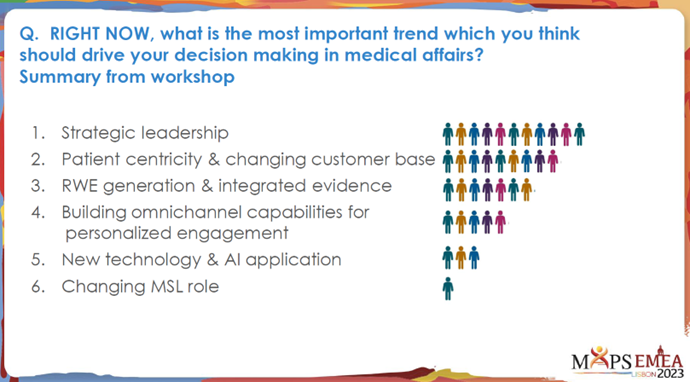
At the congress, Karen King and Mark Wheeler ran a session alongside industry partners, with a view to:- Establish 2023’s top industry trends that will shape the future of Medical Affairs teams
- Understand how to apply top industry trends to Medical Affairs planning, prioritization, and investment for 2023–2025
- Inform internal training priorities that reflect the Medical Affairs professional of the future
New technology and artificial intelligence application
Artificial intelligence (AI) was very much a hot topic at this conference, and companies already integrating AI into customer relationship management (CRM) models are demonstrating the practical applications, such as to help with customer understanding and to suggest the “next best action” for an MSL. Most organizations are exploring AI, with varying degrees of commitment and success. It was generally acknowledged that ChatGPT and similar large language tools are very much “noise,” and further exploration of the technology and a fundamental compliance overhaul will be required to take real advantage of them. In general, most workshop participants felt that their organizations were in the early days of adopting AI; however, some felt that they were already starting to see its utility behind the scenes in relation to CRM and customer understanding.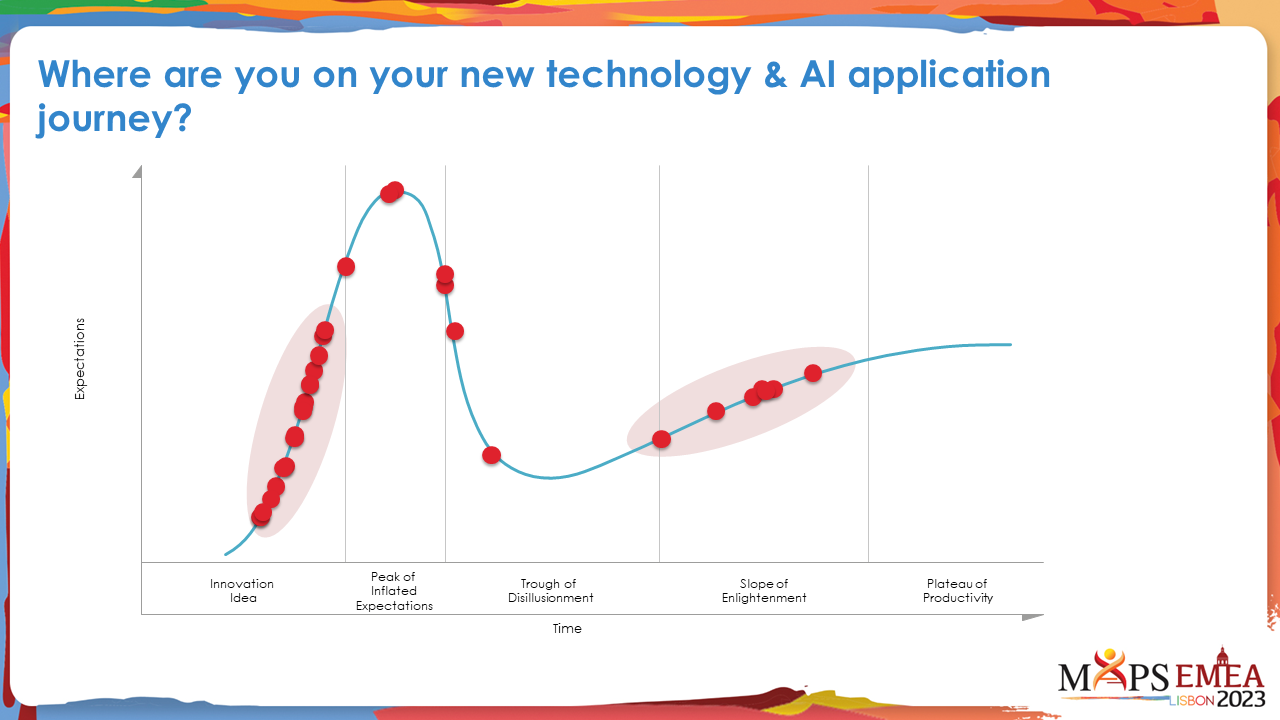
Real-world evidence generation and integrated evidence
The real-world evidence (RWE) landscape is changing, with increasing regulatory requirements around RWE generation and greater use of data analytics, allowing multiple datasets to be combined and faster data collection from electronic medical records. The future sees MSLs armed with the scientific acumen to have robust conversations on RWE with the payer audience, with clear alignment between market access and medical teams.
However, it is clear that a lot of work still must be done in this area before it is optimized. Delegates commented that having a central view and governance was critical across a company, and training on key skills such as understanding different methodologies, interpreting RWE data, and storytelling was important across Medical Affairs teams and functions. Having agreement from senior management on priorities and processes and systems in place to optimize cross-functional teams working in this area was a core focus for next actions to implement this trend within pharmaceutical organizations.
What 3 next actions would you prioritize to implement this trend in your organization? Summary from workshop
- Cross-functional team working to understand what data and resources are currently available
- Common agreement and prioritization from senior management
- Map out the end-to-end process and identify improvement areas to operationalize
Omnichannel
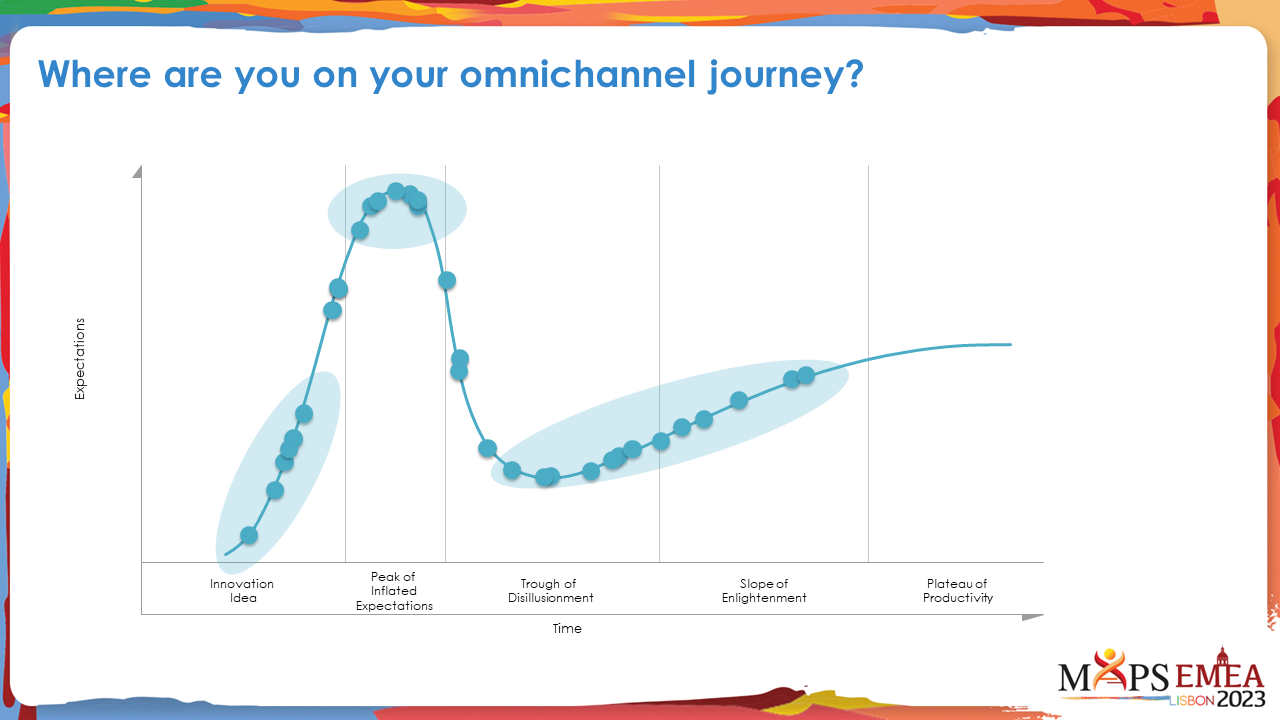
While omnichannel remains of huge interest and relevance in Medical Affairs, strategic leadership in this area is still developing. Clear alignment between omnichannel goals and leveraging cross-functional experiences are required for success. The capture, analysis, review, and interpretation of medical insights from all sources, and linking the key findings back into the medical strategy, were identified as equally critical steps. Another challenge raised was how teams can best ensure that the content they develop reaches healthcare professionals (HCPs). Many companies are investing in comprehensive portals of information to provide a one-stop shop for HCPs but often struggle with how best to personalize content to ensure that messages resonate at an individual level. Overall, it was agreed that there is a significant mindset change still required to bring Medical Affairs along the omnichannel journey.- During our workshop, omnichannel generated a great deal of conversation and debate. In this respect, the consensus was that omnichannel for Medical Affairs is still trailing behind what is being done in the commercial setting from a budgetary, technology, and mindset point of view. Of all the trends, it is telling that omnichannel and AI were the only ones not to creep onto the “Plateau of productivity” on the hype cycle, demonstrating that there is still work to do.
What 3 next actions would you prioritize to implement this trend in your organization? Summary from workshop
- Understanding and alignment of omnichannel strategy, and what Medical Affairs can deliver (value proposition)
- Skills training – hard and soft skills for Medical Affairs teams
- Innovate with what we already have in place – i.e., make what we have already work harder before moving to or developing new platforms and processes
Patient centricity
Although some felt that patient centricity was still something spoken about but not fully embraced in their organizations, many participants believed patient centricity was finally becoming a more real, tangible part of their business. Factors linked strongly to this were the level of insight now being generated on understanding patient needs and translating these insights through to more robust RWE generation.What 3 next actions would you prioritize to implement this trend in your organization? Summary from workshop
- Strategic leadership – ensure a whole-organization approach
- Dedicated expertise – as an influencer and facilitator (not just as a ‘do-er’)
- Incorporating data into patient-centric strategies
Cross-functional collaboration: Medical Affairs providing strategic leadership, by Emma Winter, OPEN Health SVP Medical and Scientific Services
During the conference discussions, it was acknowledged that cross-functional collaboration between medical and commercial teams still needs further optimization. There is a need to better quantify and communicate the value that Medical Affairs teams provide as the third pillar between clinical development and commercial, because they bring unique insights on the needs of payers, patients, and HCPs. Medical Affairs co-leading at the pre-approval stage was considered to be critical, as this can impact brand strategy, and colleagues were encouraged to step up and be present early on in the clinical development pathway to ensure that the right decision-making happens. Medical Affairs is clearly on an exciting journey of leadership and innovation. OPEN Health leverages our scientific acumen and multidisciplinary expertise to:- Partner with Medical Affairs teams to generate actionable insights and data, leveraging these in integrated strategic plans
- Create personalized, evidence-based communications for healthcare professionals, payers, and patients
- Be at the forefront of the evolving Medical Affairs environment, unlocking unique approaches to maximize clinical, societal, and economic value