
At the ESMO Congress 2025, held last month in Berlin, AI was a frequent thread in the presented content. The event, sponsored by the European Society for Medical Oncology (ESMO), was attended by some 37,000 clinicians, researchers, and others with a compelling interest in oncology. In abstracts, posters and presentations, AI-powered tools were shown to influence how data are created and deployed in clinical, regulatory, and reimbursement settings.
ESMO 2025 reinforced that AI’s potential in oncology depends on disciplined validation and thoughtful integration, not just technological progress. Even as AI reshapes how oncology evidence is generated, the quality of that evidence will rely on the transparency and accountability that are built around it.
All this signals that teams leading evidence generation, including in Medical Affairs and HEOR & Market Access, are at an important turning point. As oncology continues to advance toward precision medicine, evidence strategies must adapt to both the complexity of AI-enabled data and the increasing expectations of stakeholders who rely on it.
The following examples provide a brief snapshot of how innovations in AI are being translated into real-world practice today and redefining how oncology evidence is generated and applied.
AI foundation models and clinical relevance
AI foundation models trained on electronic health record data have continued to evolve.¹ Although they can identify patient patterns and predict outcomes at scale, these models still depend on limited datasets and validation metrics that are not clinically meaningful. There was a call for wider, multi-institutional collaborations and medical-specific benchmarking frameworks that assess AI performance using endpoints such as survival, disease progression, and toxicity.
A validation framework for AI biomarkers
The ESMO Basic Requirements for AI-Based Biomarkers in Oncology (EBAI) framework was introduced at the event in advance of publication in Annals of Oncology. Developed from a modified Delphi consensus process involving a panel of 37 experts, the publication offers guidance on using AI-derived biomarkers in cancer treatment, classifying them by novelty and evidence requirements²:
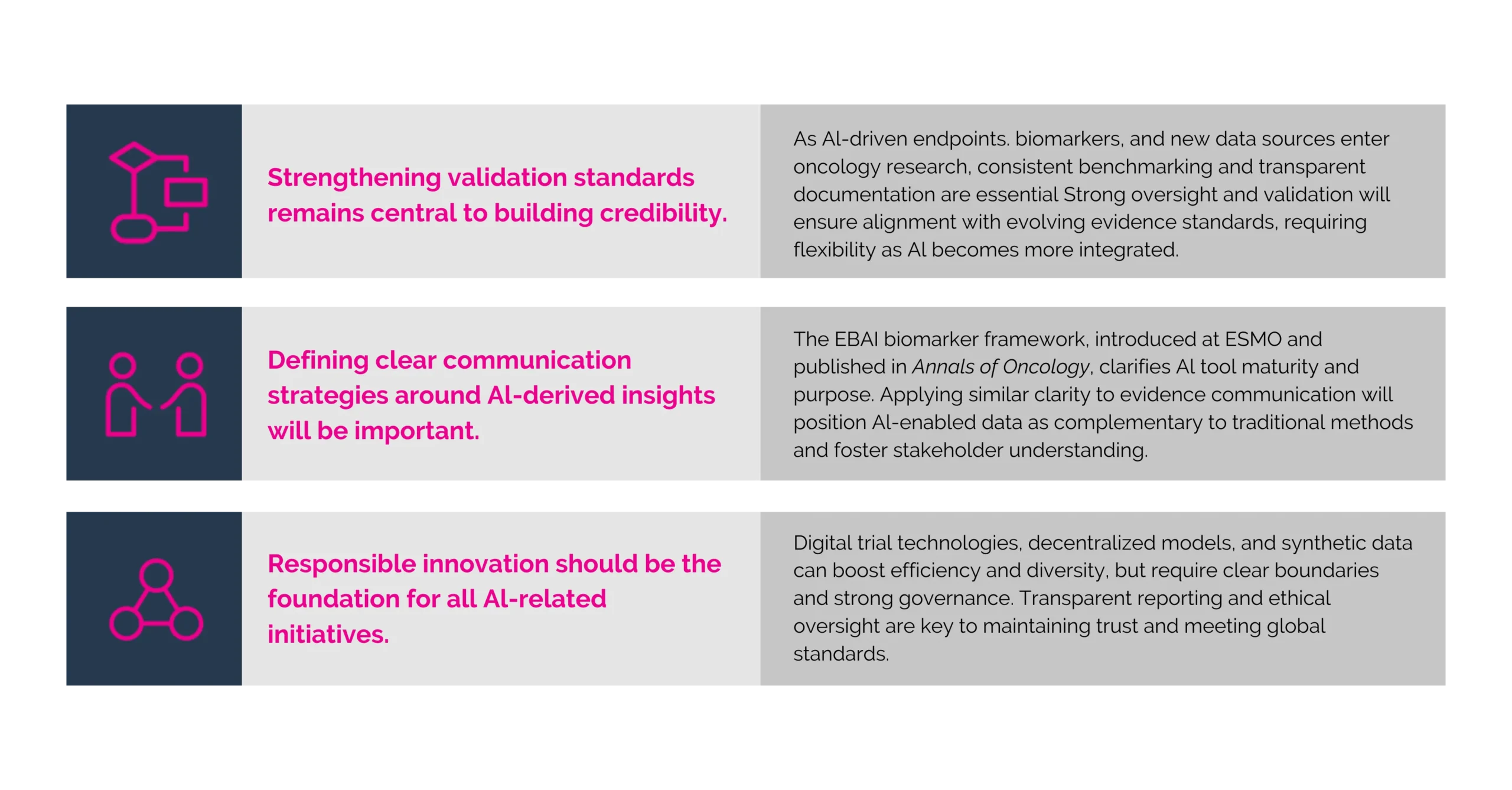 Taken together, the discussions at ESMO Congress 2025 signal that oncology evidence generation is entering a hybrid era in which AI and traditional research approaches converge. Building on this momentum will require continued collaboration, transparency, and commitment to quality to ensure AI strengthens the integrity and impact of oncology research.
References
- Class A biomarkers apply AI to automate measurement of known markers, such as PD-L1 quantification.
- Class B biomarkers approximate existing markers using alternative data types, such as digital histology.
- Class C biomarkers generate new digital markers predictive of treatment response or resistance.
Taken together, the discussions at ESMO Congress 2025 signal that oncology evidence generation is entering a hybrid era in which AI and traditional research approaches converge. Building on this momentum will require continued collaboration, transparency, and commitment to quality to ensure AI strengthens the integrity and impact of oncology research.
About OPEN Health
At OPEN Health, we connect visionary minds, pioneering science, and advanced technology to drive real impact. By uniting people, science, and technology, we activate new opportunities for biopharma innovation. Our expertise across medical affairs and market access unlocks faster, smarter routes to market. We are committed to improving patient outcomes worldwide. CAN WE HELP? For information about OPEN Health’s services and how we could support you, please get in touch. JOIN US Visit our careers page to view opportunities at OPEN Health. Contact usReferences
- Curtis C. AI-Based Drug Discovery for Oncology. Presented at: ESMO Congress 2025; Berlin, Germany; October 2025.
- Aldea M, Salto-Tellez M, Marra A, et al. ESMO Basic Requirements for AI-based Biomarkers in Oncology (EBAI). Ann Oncol. 2025; doi:10.1016/j.annonc.2025.11.009
- Vaz-Luis I. ESMO 2025. Digital Infrastructure for Clinical Trials. Presented at: ESMO Congress 2025; Berlin, Germany; October 2025.
- Prelaj A. ESMO 2025. AI-Based Procedures to Augment Clinical Trials. Presented at: ESMO Congress 2025; Berlin, Germany; October 2025.
- ESMO 2025. Proffered Paper Session, AI & Digital Oncology. Presented at: ESMO Congress 2025; Berlin, Germany; October 2025.