A patient walks into clinic. The physical exam indicates an EASI score of 50, suggesting a partial response to treatment. By the patient’s own account, they are not sleeping, not working, not coping, and their itch score is 10 out of 10. The EASI score is providing a measure of their disease, but it does not measure everything.new options, ESMO brought the oncology community face to face with the friction of real-world delivery.
Clinical assessment and patient experience are not yet aligned
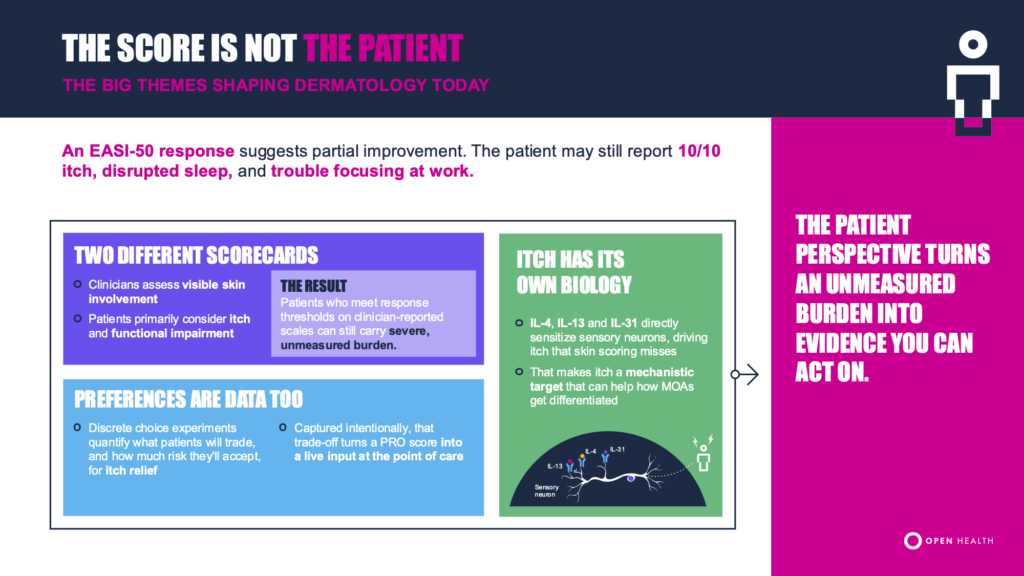
Physician and patient assessments of atopic dermatitis (AD) severity systematically diverge.1 Patients primarily consider itch and functional impairment; clinicians assess visible skin involvement. The result is a well-documented gap in which patients meeting response thresholds on clinician-reported scales may continue to carry severe, unmeasured burden. More than half of patients with moderate-to-severe AD have depressive symptoms,2 and sleep disruption, one of the most consistently reported patient concerns, only weakly correlates with EASI.3
Patient-centric decision-making requires patient-centric evidence
Patient-reported outcome (PRO) instruments (e.g. PP-NRS, POEM, DLQI) capture what EASI cannot, but they remain underused as secondary endpoints in both trial design and clinical practice.1,4 Most dermatologists are trained to assess what they can see, and embedding PRO interpretation into routine care requires a meaningful behavior change. Closing that gap takes more than better instruments; it calls for patient engagement that surfaces what matters most to patients, and targeted HCP education that makes PRO interpretation part of routine practice. Preference research adds a layer here too. Methods such as discrete choice experiments quantify how patients trade itch, sleep loss, and functional impairment against one another, and the risks they will accept to relieve them.5 This provides evidence that matters most once you know which of those trade-offs has a real biological basis.
Capturing patient-centric outcomes will be critical for establishing the value of pipeline itch-targeting agents
Itch in AD also has its own biology, independent of the inflammatory cascade visible on examination. Type 2 cytokines including IL-4, IL-13, and IL-31 directly sensitize peripheral sensory neurons, promote epidermal hyperinnervation, and drive itch through neuroimmune pathways that are not captured by skin scoring systems.6 This reframes itch from a symptomatic complaint to a mechanistic target in its own right, and it provides the scientific rationale for why agents that act at the sensory level are meaningfully differentiated from those that address inflammation alone. For pipeline assets with itch-targeting components, including bispecifics pairing OX40L with IL-31 blockade, the neuroimmune narrative is not a secondary talking point. It provides the story behind the primary short-term benefit for patients, and it needs to be built into scientific platforms accordingly.
Crucially, the outcomes that best capture this biology (i.e. itch severity, sleep loss, and functional impairment) are precisely the ones that EASI cannot assess and that PRO instruments are designed to measure. This is also the kind of trade-off preference research is built to quantify. With multiple systemic and biologic treatment options and no single right answer for every patient, evidence on how much risk someone will accept for itch relief turns a PRO score from a number on a chart into a live input at the point of care.
In a field that has historically built its evidence base largely around what is visible and quantifiable, tools and language to capture what patients actually live with are in relative infancy. Successful sponsors will be those who can rapidly and meaningfully integrate them into evidence and communication plans that empower confident decisions.
Translating datapoints to decisions with OPEN Health
At OPEN Health, we can support your full patient experience strategy end to end, from instrument selection to the payer value story. We unite Evidence & Access, Patient Engagement and Medical Affairs & communications to design patient engagement and co-creation initiatives that embed the patient voice in your evidence base and integrate it into resources that bring the patient voice into the consultation..
If your communication strategy still leads with EASI data alone, it may be leaving the most compelling part of your story untold. Let’s talk.
References
[1] Wei W et al. Discordance Between Physician- and Patient-Reported Disease Severity in Adults with Atopic Dermatitis: A US Cross-Sectional Survey. Am J Clin Dermatol 2017;18:825-835. PMC5680372
[2] Ivert LU et al. The Impact of Systemic Treatment of Atopic Dermatitis on Depressive Symptoms: A Prospective Clinical Cohort Study. Acta Derm Venereol 2022;102:803. PMC9677256
[3] Lei D et al. Validation of four single-item patient-reported assessments of sleep in adult atopic dermatitis patients. Ann Allergy Asthma Immunol 2020;124:261–266. PubMed 31830585
[4] Ojeda IC et al. Patient-Reported Outcome Measures in Atopic Dermatitis and Chronic Urticaria Are Underused in Clinical Practice. J Allergy Clin Immunol Pract 2024;12:1575-1583. PubMed 38604531
[5] Durno N et al. Biologics and oral systemic treatment preferences inpatients and physicians for moderate-to-severe atopic dermatitis: a discrete choice experiment in the United Kingdom and Germany. J Dermatolog Treat 2024;35:2417966. PMC39462516
[6] Jha MK et al. Type 2 cytokines pleiotropically modulate sensory nerve architecture and neuroimmune interactions to mediate itch. J Allergy Clin Immunol 2025;156:1066-1081. PubMed 40436117