Published: Orphanet Journal of Rare Diseases, 2018
Background
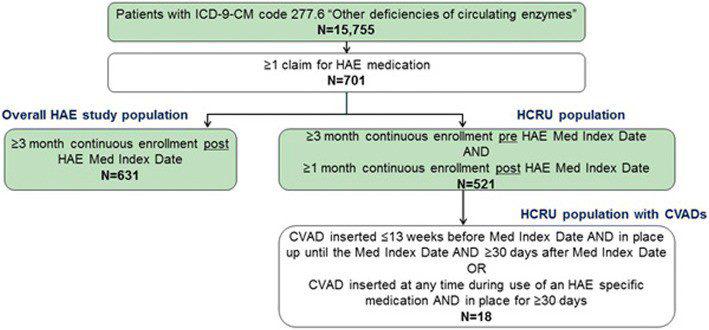
Real-world data on usage and associated outcomes with hereditary angioedema (HAE)-specific medications introduced to the United States (US) market since 2009 are very limited. The purpose of this retrospective study was to evaluate real-world treatment patterns of HAE-specific medications in the US and to assess their impact on healthcare resource utilization (HCRU). This analysis used IMS PharMetrics PlusTM database records (2006-2014) of patients with HAE, ?1 insurance claim for an HAE-specific medication, and continuous insurance enrollment for ?3 months following the first HAE prescription claim.
Results
Of 631 total patients, 434 (68.8%) reported C1-INH(IV) use; 396 (62.8%) reported using ecallantide and/or icatibant. There were 306 episodes of prophylactic use of C1-INH(IV) (defined by continuous refills averaging ?1500 IU/week for ?13 weeks) in 155 patientspatients (5.4%) had a central venous access device (CVAD); of these, 5 (27.7%) required hospitalization and 14 (77.7%) had an ED visit. The adjusted relative risk of hospitalization and/or ED visits for patients with a CVAD was 2.6 (95% CI: 0.17, 39.23) compared to C1-INH(IV) users without a CVAD.
Conclusions
Despite widespread availability of modern HAE medications in the US, we identified a subset of patients requiring long-term prophylaxis who continue to be burdened by frequent rescue medication usage and/or complications related to the use of CVADs for intravenous HAE medication.